Materials
Chanderi, the cloth called woven air
The Journal · August 29, 2026 · 2 min read
Updated

A sheer handloom cloth from Madhya Pradesh, woven in silk, cotton or both, with small motifs worked in by hand. How to know it and how to wear it.
The short answer: Chanderi is a fine, semi-transparent handloom cloth from the town of Chanderi in Madhya Pradesh. It is woven in three forms, pure silk, silk-cotton and pure cotton, usually with zari in the border and small motifs woven into the body. The name is protected in India as a geographical indication.
What gives it the look
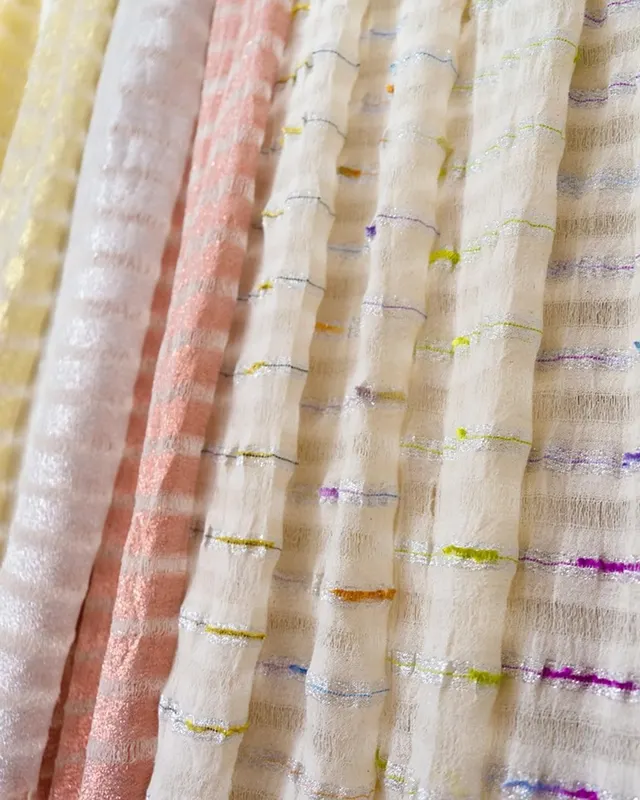
Two things: fine yarn and an open, even weave. Together they make a cloth light enough to be nicknamed "woven air", with a soft glow rather than a hard shine. Hold a single layer over a printed page and you should be able to make out the words through it.
In most Chanderi made today the warp, the lengthwise yarn, is silk and the weft is cotton or silk. Silk-cotton is the commonest of the three types and the easiest to wear in heat.
The motifs
The small figures scattered across a Chanderi are called butis. They are not printed or embroidered afterwards. The weaver works each one into the cloth by hand as the weaving goes on, with extra threads laid in by needle. Coins, flowers, peacocks and geometric forms are traditional.
Turn the cloth over. On woven butis you will see the extra threads carried on the back. A printed imitation is blank behind.
A short history
How old the craft is depends on who tells it. Local tradition places it very far back, and written accounts connect the town's weaving with royal patronage from around the twelfth and thirteenth centuries, and later with the Mughal court. What is certain is that the weaving has been continuous in one small town for many centuries, and that silk came into what began as a cotton cloth.
How to tell handloom Chanderi from a copy
- Transparency. A single layer is sheer.
- Weight. It feels almost weightless for its size.
- Butis on the reverse. Look for the carried threads.
- Small irregularities. Hand weaving leaves slight variations in the spacing of motifs and the line of the border.
- The fold. It holds a crisp fold, where a polyester copy is limp or springy.
Power-loom cloth sold as Chanderi is common. If the price is a fraction of what handloom costs, the loom was not worked by hand.
Wearing and keeping it
Chanderi is at its best as an evening stole or a dupatta, where its lightness shows. It is delicate. Keep it away from rough jewellery and bag hardware, which catch the fine yarn. Dry clean it, fold it with tissue rather than hanging it, and refold along new lines now and then so the zari does not crack along one crease.
Our Chanderi evening stole sits with the other scarves and stoles. For the silk side of it, see how to tell real silk, and for another protected Indian craft, Bagru block printing.
Sources and further reading
- Chanderi fabric, Incredible India, Ministry of Tourism, Government of India.
- chanderi
- weaving
- buying guide
Pieces in this story
 New

More from the journal
- Materials
October 31, 2026 · 3 min read
How to tell real silk from imitation
Real silk warms in the hand, shifts colour as it moves and burns like hair, not plastic. Five checks, and the one label worth asking for in India.
Read more - Materials

October 25, 2026 · 2 min read
Cashmere and pashmina: what the two words mean
Both are the soft undercoat of a goat. Cashmere is defined by how fine the fibre is; Kashmir Pashmina is defined by where and how it is made.
Read more - Materials
October 19, 2026 · 2 min read
Momme: how silk is weighed
Silk is sold by weight, not thread count. One momme is about 4.34 grams per square metre, and the number tells you how a scarf will drape.
Read more


